
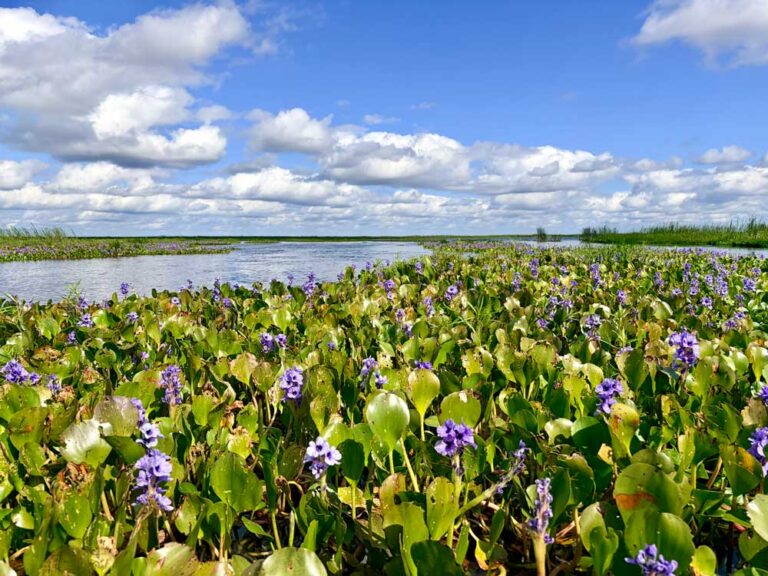
My cast landed in the slick area right before the water narrowed down between some swamp grass. If this were a pool on a stream, we’d call it the tailout. It was textbook ambush water, the kind of place you’d expect a heavy brown trout to be waiting. But this was the Iberá Wetlands. There were no trout here.
There were predators of another kind. Bigger. Meaner.
Strip. Strip. Strip.
A violent yank and I reflexively clutched the rod handle tighter. Forty-five feet from the boat, a massive boil churned the surface. In that split second, the advice the guide had given me vanished. Instinct took over. I lifted the rod, trout-style.
Gone.
“Strip set,” Juan, my guide, said calmly, almost emotionless. “No trout set. Cast again.”
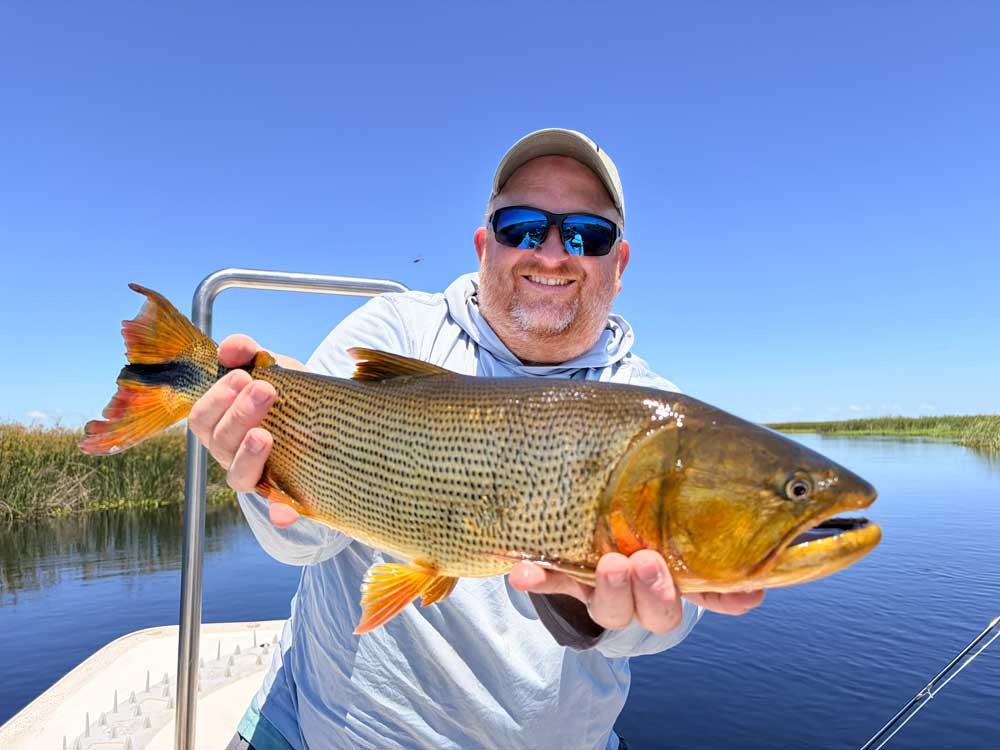
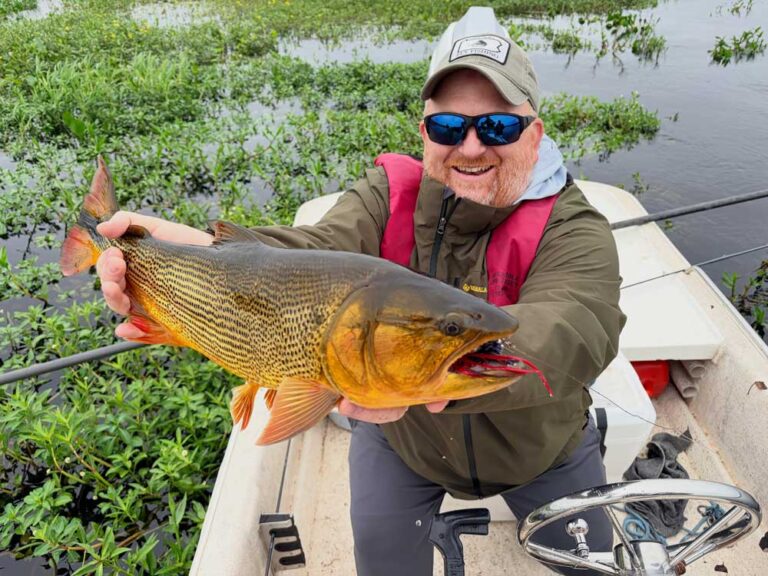
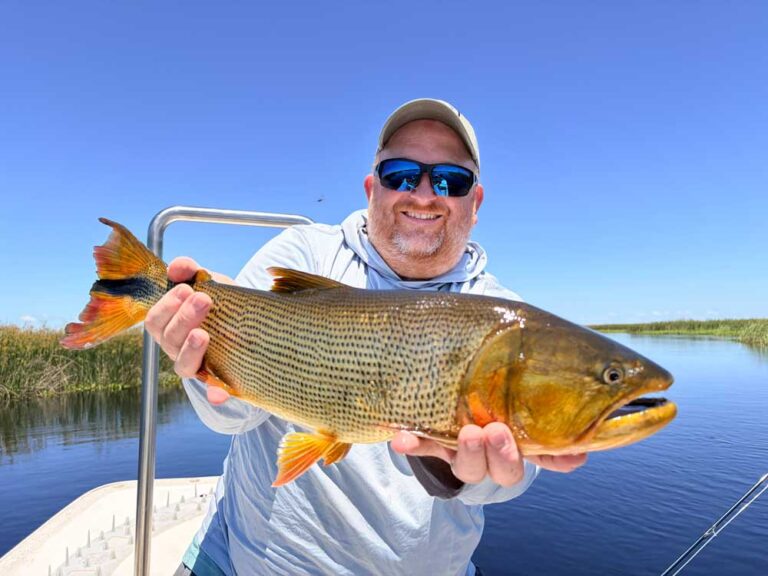
My next opportunity came about two hours later. A wider channel cut through the swamp and my streamer landed in the slack water just beyond the main current. I may have stripped the fly once – I can’t recall – but it happened fast. I felt the strike and remembered to strip set. The hooks drove home into the bony mouth of about five pounds of golden fury that immediately went airborne once, twice, three times!
And then I felt the power and a series of blistering runs that came one after another. Fly line tore through my fingertips so fast it burned a line across my skin and I regretted not wearing my casting gloves from the start. By the time we finally brought the fish to the net, it felt like I hadn’t just landed my first Golden Dorado; I’d survived it.
A Mysterious Apex Predator
Golden Dorado are apex predators. They are native to these wetlands and this river system, and they are king. Until you’ve seen the explosiveness and quickness of a 25-pound fish eating an 8-inch fly, you don’t fully grasp what that means – how violence and precision can exist in the same instant, how a fish can erase distance in a blink, how the water itself seems to detonate around them. It isn’t just a strike; it’s an assertion of dominance, a reminder that here, everything else is prey.
And they can grow big. A solid trophy is anything over 20 pounds, anywhere they are found, and they can reach 50+ pounds. But even the smaller Golden Dorado are built like tanks and don’t tame easily. They’re thick-shouldered fish with powerful jaws made for one purpose: catching prey.
The Water Erupts!
All of our guides recommended a fast strip. “You can’t strip the fly fast enough for a Golden Dorado,” they said.
At one point, Pete decided to tuck his rod handle into his armpit and do a two-handed retrieve. Not only would this move the fly faster, of course, but if he did get a strike, he could strip-set quickly and maintain tension.
As evening slowly faded into night, Emiliano motored us to a rocky stretch along the south shore of the river. Pete stood on the front platform and I stood on the back. I could see the shoreline, but it was dark enough that I couldn’t see exactly where my fly was landing. As we came to a little cove, I anticipated my next cast just as the boat was about to turn slightly to follow the contour of the shoreline. I never had the chance to make that next cast.
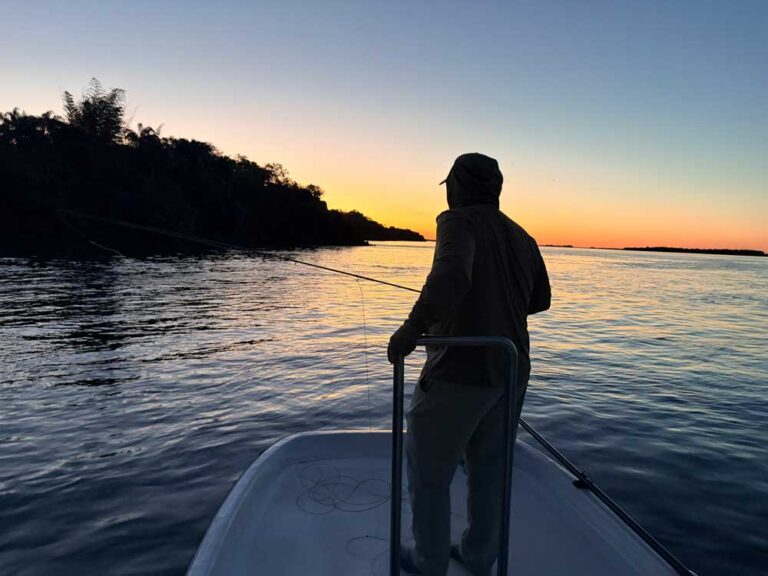
The water absolutely erupted 45-50 feet out from the boat. All I saw was frothy white water breaking up the calm darkness, and then this massive fish that was in the cove one second, and then completely on the other side of the boat heading for the middle of the river the next! It came to tension as Pete jerked in line and the fish went airborne – this huge golden mass leaping into the darkness!
Eventually Pete got it on the reel. The fish jumped again, made another bullish run taking Pete into his backing.
“Big dorado!” said Emiliano. “More than 20 pounds!”
The sheer power of the fish was impressive. Its speed through the water and the sheer violence of the creature were incredible.
The tension in the boat was palpable as Pete played the fish. Pete hadn’t caught a fish the past two days on the Upper Parana. He’d mentioned preferring the wetlands for the consistent action. But this fish…
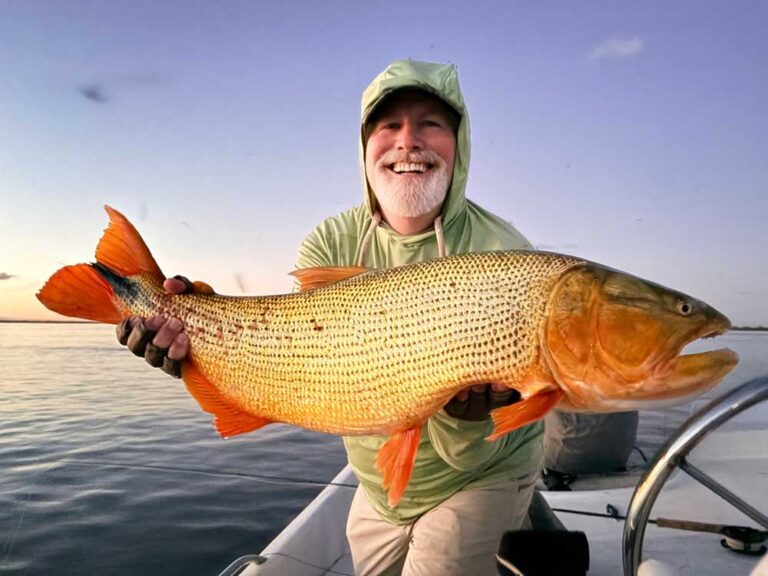
The behemoth made a slow, weary pass by the boat. The guide missed it with the net on the first attempt. On the second try, the Golden Dorado got halfway in and then flopped out of the net. But the third time – laser focus! – the guide swooped the net and secured what was easily a 25-pound Golden Dorado! We whooped and hollered and high fived!
I’ve always believed one big fish can change everything. Reviewing the photos of Pete holding up that monster dorado and the sheer look of joy on his face, I still believe that to be true.
Editor’s note: This story is an excerpt from a longer piece by Ralph Scherder from Dark Skies Fly Fishing exploring fly fishing for Golden Dorado across Argentina. You can read the full article here.
